“In fact, India has since 2004 lost more lives to terrorist incidents than all of North America, South America, Central America, Europe and Eurasia put together. All of these vast swathes of the globe lost a total of 3,280 lives in terrorist incidents between January 2004 and March this year. India alone lost 3,674 lives over the same period of three years and three months.”Other recent stories in the Times of India tell of the arrests of 10 people in connection with the blasts, who are suspected of smuggling the explosive RDX from the predominantly Muslim nation of Bangladesh, in which the Harkat-ul-Jehad Al-Islami jihad group is based, and one detainee’s provision of mobile phone SIM cards (used to detonate IEDs) to a “terror module” in the city. The Times of India Web site and the archives of both Jihad Watch and the Counterterrorism Blog have much information on this oft-overlooked front in the global jihad.
Thursday, September 13, 2007
Jihad in India
On Aug. 25, jihad bomb attacks on an amusement park laser show and a restaurant in the Indian city of Hyderabad killed 30 people and wounded 60 – just the latest atrocities in a terror campaign that has left India second only to Iraq in the number of terrorism casualties over the past three years, according to the Times of India:

Tuesday, September 11, 2007
Then, as now ...
What makes Muslims feel better about unbelievers? The Qur'an (verses (9:14-15) says it:
“Fight them, and God will chastise them at your hands and degrade them, and He will help you against them, and bring healing to the breasts of a people who believe, and He will remove the rage within their hearts; and God turns towards whomsoever He will; God is All-knowing, All-wise.”1
LGF shows it.
“Fight them, and God will chastise them at your hands and degrade them, and He will help you against them, and bring healing to the breasts of a people who believe, and He will remove the rage within their hearts; and God turns towards whomsoever He will; God is All-knowing, All-wise.”1
LGF shows it.
Monday, September 10, 2007
Great minds think alike

“One principle must be absolute for the SS man: we must be honest, decent, loyal and comradely to members of our own blood and to no one else.”
– Heinrich Himmler, Reichsfuhrer SS, in a speech to SS group leaders in Poznan, Poland, Oct. 4, 1943.1

“ ... ‘kind and generous towards their own people and ruthless against our enemies at home and abroad’.”
– Reinhard Heydrich, Obergruppenfuhrer SS, describing the SS creed in a 1939 letter to his wife.2

“Muhammad is the Messenger of God, and those with him are hard against the unbelievers, merciful one to another.”
– Muhammad, prophet of Islam; in Qur’an 48:29.3
up1 From records of the Trial of Major War Criminals before International Military Tribunal, Nuremburg, 1947-1949; cited in “The Face of the Third Reich: Portraits of the Nazi Leadership,” by Joachim C. Fest.
up2 Quoted in “Der Spiel ist aus,” Der Spiegel, Feb. 19, 1950; cited in “The Killing of Obergruppenfuhrer Reinhard Heydrich,” by Callum Macdonald.
Sunday, September 9, 2007
Demands, then denial
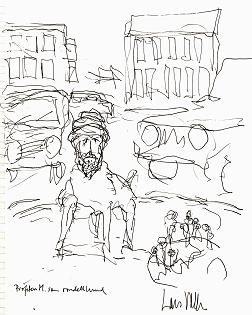
According to both Muslim ambassadors and Swedish Prime Minister Fredrik Reinfeldt, Friday’s meeting concerning the printing by Swedish newspapers of artist Lars Vilks’s drawings on the theme of “Muhammad as a traffic-circle dog” went off swimmingly. Iran’s ambassador Hassan Ghashghavi told the Swedish news agency TT afterward that “the Swedish government has handled this situation well,” while Reinfeldt spoke of a “very positive dialogue.” Representatives of both sides denied that a list of Muslim demands trumpeted by Egyptian ambassador Mohamed Sotouhi Thursday had ever been presented: Reinfeldt said “There were no demands in that sense,” a denial echoed by Syria’s ambassador Mohammad Bassam Imadi: “We have no list of demands, on the contrary, we are here to bring two sides together where there is a problem.”
But given the stridency of Sotouhi’s Thursday statements to TT and his disclosure that “he and a group of fellow ambassadors had agreed” on a list of “comprehensive measures,” it is hard to see such feel-good characterizations as anything but a mendacious whitewash of what went on an official meeting from which the press was excluded. While a letter presented by the ambassadors to Reinfeldt and “obtained by” (read: “handed on a silver platter to”) the newspaper Expressen contained no demands per se, Sotouhi listed three very specific ones:
* Targeted censorship: "Muslims need legal protection against the desecration of the Prophet Muhammad."
* Sensitivity indoctrination in schools and newsrooms: "The school curriculum has to convince pupils that if they want to express their opinion they should do so in such a way that it doesn't cause offence or hurt. This should also be part of journalism training."
* Political correctness enforcers: “A permanent parliamentary committee also needs to be established to tackle Islamophobia.”
In short, the Swedish press – which didn’t generate the “Muhammad as a roundabout dog” sketches but was only doing its job by printing them with its coverage of the controversy surrounding them – must be censored, indocrinated, and monitored by a parliament whose members, this story indicates, would be only too glad to clip their wings.
If Swedish journalists want to preserve their rights, they had better do some digging to find out what really happened during Friday’s meeting. Is it really to be supposed that, having declared Thursday that “We want to see action, not just nice words,” Sotouhi and his fellow Muslim ambassadors settled the next day for nothing more than “very positive dialogue”? Did Reinfeldt agree to any of the items on Sotouhi’s wish list? Did he pass the buck to a Swedish parliament in which hostility toward freedom of the press has been documented by a professionally conducted survey? Not only the public but journalists themselves urgently need to know.
Thursday, September 6, 2007
‘A spirit of appeasement’
In the wake of official complaints about Swedish newspapers' printing of Lars Vilks's Muhammad sketches from Iran, Pakistan, Afghanistan, Jordan, Egypt and the Organization for the Islamic Conference, Sweden’s Prime Minister Fredrik Reinfeldt has agreed to a meeting tomorrow with ambassadors from 20 Muslim nations. Among the demands for which they will press, as Egyptian ambassador to Sweden Mohamed Sotouhi told the news agency TT, are sensitivity indoctrination for journalists, a “permanent parliamentary committee ... to tackle Islamophobia,” and “a change in [Swedish] law” offering Muslims “protection from the desecration of the Prophet Muhammad.”
In short, complete immunity from criticism for Muslims and their creed. And the Muslim diplomats expect nothing less than abject submission, as Algeria’s ambassador Merzak Bedjaoui made clear in calling the meeting “an excellent initiative taken in a spirit of appeasement.”
All in keeping with Qur’anic scripture, to wit: Verses 48:29, which declares that Muslims are “hard against the unbelievers”; 9:123, which exhorts them to “let them find in you a harshness”; and 9:29, which enjoins them to fight unbelievers until they “feel themselves subdued.”
In short, complete immunity from criticism for Muslims and their creed. And the Muslim diplomats expect nothing less than abject submission, as Algeria’s ambassador Merzak Bedjaoui made clear in calling the meeting “an excellent initiative taken in a spirit of appeasement.”
All in keeping with Qur’anic scripture, to wit: Verses 48:29, which declares that Muslims are “hard against the unbelievers”; 9:123, which exhorts them to “let them find in you a harshness”; and 9:29, which enjoins them to fight unbelievers until they “feel themselves subdued.”
Wednesday, September 5, 2007
Judensau – ‘a parody of a caricature’
Swedish artist Lars Vilks, whose sketches of Muhammad as a rondellhund (traffic-circle dog statue) ignited the reprise of the cartoon jihad chronicled in the foregoing post, has explained his drawing of a "judensau" to the Swedish news agency TT:
Roger that. My second language being Russian rather than Swedish, I didn't catch Vilks's clarification on his blog, but am glad to have it now.
Vilks said he had observed how Muslims were treated with greater care than other religious groups. It was with this in mind that he composed the drawing 'Modern Jewish sow, swollen by capitalism', a drawing he published on his own website as a response to a rhetorical question from a Swedish journalist.
"The 'Jew sow' is crystal clear and belongs to a particular situation. It's a parody of a caricature, it's so over-explicit. I understand that the picture itself in another context could be explosive. But I'm no anti-Semite.
"Otherwise I wouldn't have written the accompanying text about how Muslims are able to have a go at Jews in the roughest manner without any reaction because people are afraid to attack Muslims," said Vilks.
Roger that. My second language being Russian rather than Swedish, I didn't catch Vilks's clarification on his blog, but am glad to have it now.
Scrawls of fury
Swedish artist’s Muhammad sketches rekindle cartoon rage

When a story about the removal of a few sketches of Islam’s prophet Muhammad from an art exhibit in a Swedish town began to show up on an American blog in late July, it seemed a bagatelle – even after last year’s furor over a Danish newspaper’s publication of a dozen such caricatures in 2005. Since then, however, Lars Vilks’s puckish depictions have sparked controversy and been printed in several newspapers in his native country, prompting official protests in the Muslim world and death threats to the artist himself. We appear to be on the verge of “Cartoon Jihad II.”
The affair began on July 20, when Vilks – whom Swedish correspondents at Gates of Vienna, the blog that has done an excellent job of keeping up on this story, have variously referred to as “a well-established Swedish artist,” an “oddball” and “a total whacko” – provided three drawings for an art show in Tallberg, near Karlstad, on the theme of “The Dog in Art.” Vilks’s renditions depicted “rondellhunds” bearing the head of Muhammad. (Rondellhunds – “traffic circle dogs” – are a charmingly whimsical Swedish craze: wooden statues of dogs created and placed in traffic circles by persons anonymous.) When, shortly before opening of the exhibit, its organizers discovered what they had on display, they took Vilks’s drawings down in a panic over the anticipated reaction from thin-skinned Muslims.
“We didn’t understand how serious this was at first,” exhibit organizer Marta Wennerstrom told the newspaper Svenska Dagbladet. “I think that the drawings are good. But there is also a fear here at the homestead museum that it will lead to problems and uproar.” Vilks’s reaction: “So much for freedom of speech.” It is likely, however, that the artist sought just such a response – for, as he states on his Web site: “Only to an entirely insignificant extent is the art located in the drawings. The substantial center of gravity is in the observers’ experience and reaction.”
There it might have ended – a tempest in the minuscule teapot of the Swedish art scene. But the story grew legs in the Scandinavian media, particularly after the Gerlesborgskolan, an art school in Hamburgsund, also barred Vilks’s drawings from a show in mid-August, citing “security considerations.” Beginning with the paper “Barometern” on Aug. 15, the Swedish press began to print Vilks’s drawings with their coverage of the affair. Nerikes Allehanda followed with one on Aug. 18, as did Aftonbladet on Aug. 20 and Dagens Nyheter on Aug. 22, the latter with the cutline, “ ‘Mohammed as a roundabout-dog’ isn’t primarily a caricature of Mohammed or ‘Islam’ — but of the world of art. And judging by everything, it hit the bull’s-eye.” To the drawing Sydsvenskan ran on Aug. 24 it added a sketch of a “Jewish sow” Vilks had inked in response to a dare by Ingmarie Froman of the paper Svenska Dagbladet.
Vociferous reaction to the pictures’ publication from the Muslim world was not long in coming. On Aug. 24, a group of about 60 Muslims in the Swedish city of Orebro held a demonstration at the editorial offices of Nerikes Allehanda to protest the paper’s printing of one of the offending images with an editorial decrying art officials’ refusal to show Vilks’s drawings as “unacceptable self-censorship.” Two days later, the Iranian foreign ministry in Tehran summoned the Swedish charge d’affaires and issued an official protest of its own, as Iranian President Mahmoud Ahmadinejad fulminated that the cartoon was the work of “Zionists” who “thrive on conflict and war.” On Aug. 30, Pakistan’s foreign ministry also summoned the Swedish charge d’affaires for a dressing-down, and that same day the secretary-general of the 57-nation Organization of the Islamic Conference, Elkemeddin Ihsaoglu, demanded judicial sanction for the “blasphemous caricature,” blasting its publication as “irresponsible and despicable.” On Sept. 1 Afghanistan’s Ministry of Islamic Guidance in a statement in the Kabul Times echoed the OIC’s demand for punishment, as did Egypt’s Ministry of Religious Endowments the next day. On Sept. 3 a Jordanian government spokesman condemned the publication of the drawings, declaring that it “does not serve inter-faith dialogue and co-existence.” And in the small hours of the morning on Sept. 4, vandals in Orebro torched several hundred copies of Nerikes Allehanda awaiting delivery to readers.
In the face of all this the Swedish government and press establishment have shown a surprising amount of backbone. Newspaper editors have firmly rejected demands for apology, and even Swedish Prime Minister Fredrik Reinfeldt was moved to declare his nation “eager to stand up for freedom of expression, which is enshrined in the constitution and comes naturally to us, and which ensures that we do not make political decisions about what gets published in the newspapers.” At a second Muslim demonstration on Aug. 31 against Nerikes Allehanda (around which most of the official condemnations in the Muslim world have centered) in Orebro – this one with some 300 in attendance instead of only 60 – a detachment of the Liberal Party’s youth wing showed up to countervail the protesters, with a spokeswoman who asserted that “Freedom of expression is absolutely central.”
Indeed it is – and it is good to see at least some liberals standing up for what are (or ought to be) quintessentially liberal values. It is also good to see the press in Sweden not only defending its rights but exercising them, which the overwhelming majority of American news media signally failed to do during the Danish cartoon jihad last year. Despite the latter story’s intensity and its direct impact on journalism itself, only three major American papers – the Philadelphia Inquirer, the Austin American-Statesman and the Rocky Mountain News in Denver – had the integrity to print any of the offending caricatures with their coverage and commentary on the issue. The rest offered weasely justifications for their pusillanimity, such as the Feb. 7, 2006 New York Times editorial that called that paper’s reticence “a reasonable choice ... especially since the cartoons are so easy to describe.”
Ease of description, of course, was not the point. The point was to properly practice journalism by printing the Danish cartoons to show readers what the fuss was about and enable them to decide whether it was warranted. “The people’s right to know,” it’s called – and the people certainly had a right to know what was fueling the Islamist fire that would leave at least 139 dead and 823 injured in the cartoon jihad. The point, moreover, was to push back against the malign sentiments expressed on placards and banners borne by Muslim throngs worldwide – which, in addition to calls for the deaths of the cartoonists and their editors, included, in Pakistan, “Our religion does not allow unconditional freedom of speech,” in Nigeria, “Free expression is Western terrorism,” and in Indonesia, “A Muslim’s faith is above Western values.”
Now a Muslim group, Sveriges Muslimska Förbund, is taking legal action to initiate the prosecution of the paper Nerikes Allehanda under a Swedish law prohibiting “agitation against an ethnic group” – never mind that Islam is not an ethnic group at all – and it considers not just the reproduction of Vilks’s drawing but the editorial next to it to be defamatory. “The text is about ridiculing religion,” declared Mahmoud Aldebe, the group’s chairman – though what the text really agitated against was the art world’s timorousness in shunning Vilks’s drawings.
 (A stronger defamation case could in fact be made against Vilks, Ingmarie Froman, and the paper Sydsvenskan for the “Jewish sow” cartoon, a slur considerably more vicious than portraying Muhammad as a canine statue in a traffic circle. As the British historian Paul Johnson noted in his 1987 book “History of the Jews,” for centuries in Germany the “judensau” was “the commonest of all motifs for the Jew, and one of the most potent and enduring of abusive stereotypes,” whose “endless repetition helped on a process which in Germany was to become of great and tragic importance: the dehumanization of the Jew.” Likening Jews to animals, specifically monkeys and pigs, is also a common practice among jihad-oriented Muslim clerics, as Robert Spencer points out in his new book “Religion of Peace? Why Christianity Is and Islam Isn’t.”)
The stage is set for an intensification of Islamic ire. Last Friday in Lahore, Pakistan, Muslim demonstrators burned Swedish flags and carried signs reading “Down with Sweden” and “Death to Lars.” A more widespread wave of wrath could come this Friday, when imams preach to the faithful in mosques worldwide. It was after Friday prayers that last year’s cartoon jihad exploded into violence and mass demonstrations throughout the Muslim world.
It is time for the West to teach that world that there are certain things we hold sacred, and are not about to yield to prideful zealots and their ugly tantrums. Paramount among these are the inalienable human right to freedom of expression, and the right of the press to report freely on controversies surrounding its use. Should things get hot this week, let the Swedes hold their ground – and let the American press redeem itself by not shrinking from the graphic depiction of what has prompted the furor.
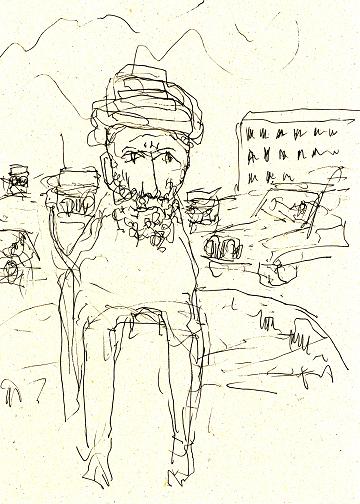
When a story about the removal of a few sketches of Islam’s prophet Muhammad from an art exhibit in a Swedish town began to show up on an American blog in late July, it seemed a bagatelle – even after last year’s furor over a Danish newspaper’s publication of a dozen such caricatures in 2005. Since then, however, Lars Vilks’s puckish depictions have sparked controversy and been printed in several newspapers in his native country, prompting official protests in the Muslim world and death threats to the artist himself. We appear to be on the verge of “Cartoon Jihad II.”
The affair began on July 20, when Vilks – whom Swedish correspondents at Gates of Vienna, the blog that has done an excellent job of keeping up on this story, have variously referred to as “a well-established Swedish artist,” an “oddball” and “a total whacko” – provided three drawings for an art show in Tallberg, near Karlstad, on the theme of “The Dog in Art.” Vilks’s renditions depicted “rondellhunds” bearing the head of Muhammad. (Rondellhunds – “traffic circle dogs” – are a charmingly whimsical Swedish craze: wooden statues of dogs created and placed in traffic circles by persons anonymous.) When, shortly before opening of the exhibit, its organizers discovered what they had on display, they took Vilks’s drawings down in a panic over the anticipated reaction from thin-skinned Muslims.
“We didn’t understand how serious this was at first,” exhibit organizer Marta Wennerstrom told the newspaper Svenska Dagbladet. “I think that the drawings are good. But there is also a fear here at the homestead museum that it will lead to problems and uproar.” Vilks’s reaction: “So much for freedom of speech.” It is likely, however, that the artist sought just such a response – for, as he states on his Web site: “Only to an entirely insignificant extent is the art located in the drawings. The substantial center of gravity is in the observers’ experience and reaction.”
There it might have ended – a tempest in the minuscule teapot of the Swedish art scene. But the story grew legs in the Scandinavian media, particularly after the Gerlesborgskolan, an art school in Hamburgsund, also barred Vilks’s drawings from a show in mid-August, citing “security considerations.” Beginning with the paper “Barometern” on Aug. 15, the Swedish press began to print Vilks’s drawings with their coverage of the affair. Nerikes Allehanda followed with one on Aug. 18, as did Aftonbladet on Aug. 20 and Dagens Nyheter on Aug. 22, the latter with the cutline, “ ‘Mohammed as a roundabout-dog’ isn’t primarily a caricature of Mohammed or ‘Islam’ — but of the world of art. And judging by everything, it hit the bull’s-eye.” To the drawing Sydsvenskan ran on Aug. 24 it added a sketch of a “Jewish sow” Vilks had inked in response to a dare by Ingmarie Froman of the paper Svenska Dagbladet.
Vociferous reaction to the pictures’ publication from the Muslim world was not long in coming. On Aug. 24, a group of about 60 Muslims in the Swedish city of Orebro held a demonstration at the editorial offices of Nerikes Allehanda to protest the paper’s printing of one of the offending images with an editorial decrying art officials’ refusal to show Vilks’s drawings as “unacceptable self-censorship.” Two days later, the Iranian foreign ministry in Tehran summoned the Swedish charge d’affaires and issued an official protest of its own, as Iranian President Mahmoud Ahmadinejad fulminated that the cartoon was the work of “Zionists” who “thrive on conflict and war.” On Aug. 30, Pakistan’s foreign ministry also summoned the Swedish charge d’affaires for a dressing-down, and that same day the secretary-general of the 57-nation Organization of the Islamic Conference, Elkemeddin Ihsaoglu, demanded judicial sanction for the “blasphemous caricature,” blasting its publication as “irresponsible and despicable.” On Sept. 1 Afghanistan’s Ministry of Islamic Guidance in a statement in the Kabul Times echoed the OIC’s demand for punishment, as did Egypt’s Ministry of Religious Endowments the next day. On Sept. 3 a Jordanian government spokesman condemned the publication of the drawings, declaring that it “does not serve inter-faith dialogue and co-existence.” And in the small hours of the morning on Sept. 4, vandals in Orebro torched several hundred copies of Nerikes Allehanda awaiting delivery to readers.
In the face of all this the Swedish government and press establishment have shown a surprising amount of backbone. Newspaper editors have firmly rejected demands for apology, and even Swedish Prime Minister Fredrik Reinfeldt was moved to declare his nation “eager to stand up for freedom of expression, which is enshrined in the constitution and comes naturally to us, and which ensures that we do not make political decisions about what gets published in the newspapers.” At a second Muslim demonstration on Aug. 31 against Nerikes Allehanda (around which most of the official condemnations in the Muslim world have centered) in Orebro – this one with some 300 in attendance instead of only 60 – a detachment of the Liberal Party’s youth wing showed up to countervail the protesters, with a spokeswoman who asserted that “Freedom of expression is absolutely central.”
Indeed it is – and it is good to see at least some liberals standing up for what are (or ought to be) quintessentially liberal values. It is also good to see the press in Sweden not only defending its rights but exercising them, which the overwhelming majority of American news media signally failed to do during the Danish cartoon jihad last year. Despite the latter story’s intensity and its direct impact on journalism itself, only three major American papers – the Philadelphia Inquirer, the Austin American-Statesman and the Rocky Mountain News in Denver – had the integrity to print any of the offending caricatures with their coverage and commentary on the issue. The rest offered weasely justifications for their pusillanimity, such as the Feb. 7, 2006 New York Times editorial that called that paper’s reticence “a reasonable choice ... especially since the cartoons are so easy to describe.”
Ease of description, of course, was not the point. The point was to properly practice journalism by printing the Danish cartoons to show readers what the fuss was about and enable them to decide whether it was warranted. “The people’s right to know,” it’s called – and the people certainly had a right to know what was fueling the Islamist fire that would leave at least 139 dead and 823 injured in the cartoon jihad. The point, moreover, was to push back against the malign sentiments expressed on placards and banners borne by Muslim throngs worldwide – which, in addition to calls for the deaths of the cartoonists and their editors, included, in Pakistan, “Our religion does not allow unconditional freedom of speech,” in Nigeria, “Free expression is Western terrorism,” and in Indonesia, “A Muslim’s faith is above Western values.”
Now a Muslim group, Sveriges Muslimska Förbund, is taking legal action to initiate the prosecution of the paper Nerikes Allehanda under a Swedish law prohibiting “agitation against an ethnic group” – never mind that Islam is not an ethnic group at all – and it considers not just the reproduction of Vilks’s drawing but the editorial next to it to be defamatory. “The text is about ridiculing religion,” declared Mahmoud Aldebe, the group’s chairman – though what the text really agitated against was the art world’s timorousness in shunning Vilks’s drawings.
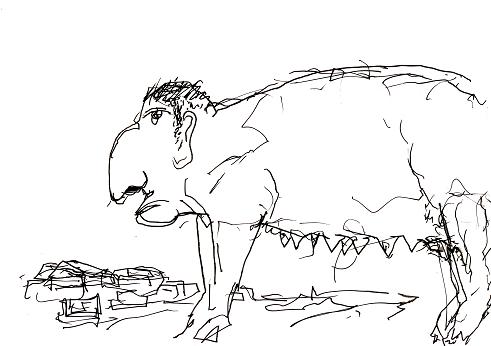 (A stronger defamation case could in fact be made against Vilks, Ingmarie Froman, and the paper Sydsvenskan for the “Jewish sow” cartoon, a slur considerably more vicious than portraying Muhammad as a canine statue in a traffic circle. As the British historian Paul Johnson noted in his 1987 book “History of the Jews,” for centuries in Germany the “judensau” was “the commonest of all motifs for the Jew, and one of the most potent and enduring of abusive stereotypes,” whose “endless repetition helped on a process which in Germany was to become of great and tragic importance: the dehumanization of the Jew.” Likening Jews to animals, specifically monkeys and pigs, is also a common practice among jihad-oriented Muslim clerics, as Robert Spencer points out in his new book “Religion of Peace? Why Christianity Is and Islam Isn’t.”)
The stage is set for an intensification of Islamic ire. Last Friday in Lahore, Pakistan, Muslim demonstrators burned Swedish flags and carried signs reading “Down with Sweden” and “Death to Lars.” A more widespread wave of wrath could come this Friday, when imams preach to the faithful in mosques worldwide. It was after Friday prayers that last year’s cartoon jihad exploded into violence and mass demonstrations throughout the Muslim world.
It is time for the West to teach that world that there are certain things we hold sacred, and are not about to yield to prideful zealots and their ugly tantrums. Paramount among these are the inalienable human right to freedom of expression, and the right of the press to report freely on controversies surrounding its use. Should things get hot this week, let the Swedes hold their ground – and let the American press redeem itself by not shrinking from the graphic depiction of what has prompted the furor.
Subscribe to:
Posts (Atom)